Five Minutes, Not Five Miles: Why a Quick Garden Fetch Earns Its Place on Dark Evenings
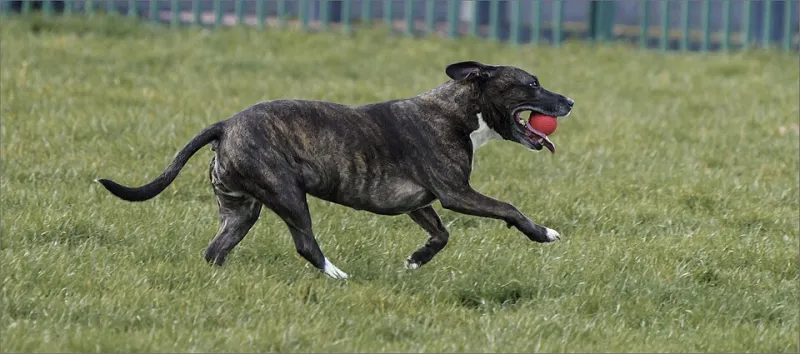
Photo: Alan Shearman, CC BY 2.0, via Wikimedia Commons
It’s 4.20pm on a Tuesday in November, the sky has that flat grey look that means business, and your dog is staring at you with the intensity of someone who has been waiting all day. Which, to be fair, they have.
The temptation is to lob a ball down the garden until everyone is too tired to argue. The better move is smaller and more deliberate: a handful of minutes, a bit of structure, and a clear understanding of what the game is and isn’t for.
A short game is not a short-changed dog
Fetch has an odd reputation. Some owners treat it as the gold standard of exercise, others as a guilty habit. Neither is quite right. A five-minute game in the garden doesn’t cancel out a walk, and it doesn’t need to. What it does is take the pressure off the days when the weather, the light and your own schedule have all conspired against you.
Think of it as a top-up. For most dogs, the most valuable part of a walk is not distance covered but information gathered — the smells, the marking, the slow reading of the neighbourhood. A brisk twenty minutes of pavement sniffing is worth more to your average spaniel than forty minutes of frantic ball-chasing on wet grass. So keep the sniffing walk where you can, shorten it if you must, and use garden play to bridge the gap rather than replace it.
There is also a behavioural argument. A short burst of controlled, cooperative play gives a dog something to do with their arousal rather than simply letting it build. The trick is that the game has to be controlled — and that is where most garden fetch sessions quietly go wrong.
Two minutes of checking before you throw anything
Before the first throw, do a quick sweep. It takes less time than finding your wellies.
- Gate and boundaries. Is the gate latched, and is the fence dog-proof in the dark as well as in daylight? A head torch is worth keeping by the back door from October onwards.
- Surface. Wet patio slabs, algae on decking and frost on grass are the three most common causes of a slipped shoulder or a tweaked knee. If the ground is greasy, move the game onto grass or shorten it.
- Hazards. Autumn brings conkers, acorns and fallen branches; winter brings antifreeze, rock salt and bulbs planted in hopeful rows. A two-minute scan is cheaper than a vet bill.
- Visibility. You need to see the dog, and drivers need to see you if your garden opens onto a lane. A reflective harness or a light-up collar tag makes a genuine difference at 5pm.
- The dog. Check paws for grit and ice, and dry the coat off afterwards rather than letting them settle damp on a sofa.
The 5-5-5 routine
The structure that busy owners actually stick to tends to be simple enough to remember without a note on the fridge. Try splitting the session into three blocks of five minutes.
Five minutes of settling in. Let the dog out, let them sniff, let them have a wee. Don’t start hurling a ball at a dog who is still half asleep on the sofa. A couple of gentle warmth-up behaviours — a few paces of loose walking, a sit, a hand touch — switch the brain on without switching it straight to maximum.
Five minutes of the game. Eight to twelve good throws, not forty scrappy ones. Break it up: two throws, then a pause for a simple cue; another two, then a bit of tug or a scatter of treats in the grass. The pauses are what keep the arousal from climbing. Finish while your dog would still happily do one more — that is the whole trick.
Five minutes of winding down. Now the game stops properly. Lead on or garden door closed, a scatter feed in the grass, a chew on a mat, a towel down. This bit is not optional. A dog who goes from full sprint to the living room in four seconds is a dog who will be pacing the hallway at nine o’clock.
Matching the game to the dog on the other end of the lead
Not every dog should be chasing a ball at speed on wet grass.
Puppies are still building joints. Keep throws low and straight, avoid twisting catches and hard stops, and treat the whole thing as a training exercise rather than a fitness one. Five minutes is plenty; three is fine.
Flat-faced breeds — pugs, French bulldogs, bulldogs, Shih Tzus — need the game slowed right down. Short, low rolls, long pauses, and a close eye on breathing. If they are snorting hard or slowing abruptly, stop. Damp cold air makes it worse.
Sighthounds want the chase, not the retrieve, and will happily redline after a ball for far longer than is sensible. Two or three sprints is a full session.
Terriers often prefer a flirt pole or a tug to a ball, and that is fine — the point is the partnership, not the equipment.
Older dogs do better with shorter, flatter throws on non-slip ground, and a warm-up that isn’t just you opening the door. If they are stiff the next morning, you overdid it.
Ball-obsessed retrievers are the ones who most need the structure in this article. A dog who screams at the sight of a lead and stares at your hand for forty minutes is not having fun; they are over-aroused, and the game is feeding it.
Reading the moment it tips over
The warning signs are usually there before the noise starts. A hard stare at your hand or pocket. A stiff, still body between throws. Barking that gets sharper and more frantic. Grabbing at the lead, your sleeve or the ball instead of releasing it. Panting hard in cold air. A tail held high and vibrating. Refusing to bring the ball back but refusing to stop either.
If you see two or three of those together, the session is finished. Don’t shout, don’t chase, don’t throw once more to ‘settle them’. Put the ball away, scatter a handful of treats into the grass, and let sniffing do the work. A dog who ends the game calm learns that calm is where the game ends. A dog who ends it over-aroused learns the opposite.
Making it survive a British winter
Keep a kit by the door: one ball on a rope, a towel, a head torch, a pot of treats. One ball, not five — a bag of balls encourages frantic retrieving and gives you nothing to trade with. Decide the garden rules and don’t bend them because it’s cold and you want it over with quickly.
And be realistic about the weather. On the nights when the Met Office has a yellow warning out and the garden is a pond, skip the fetch and do five minutes of indoor scent work instead — scattered kibble, a cardboard box, a snuffle mat. Your dog will not remember that it wasn’t a ball. They will remember that you turned up.