Ask for Space, Not a Verdict: Better Greetings on UK Dog Walks
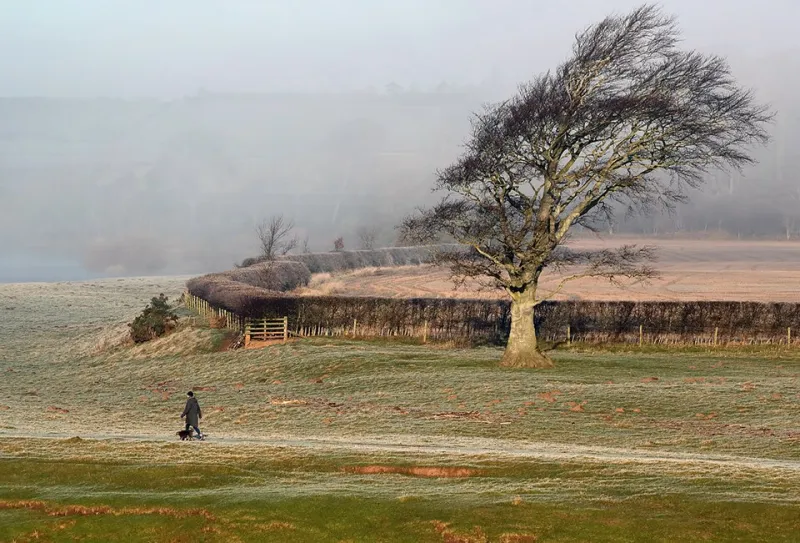
Photo: Walter Baxter, CC BY-SA 2.0, via Wikimedia Commons
On a narrow pavement, with a bus idling and a pushchair coming the other way, the phrase arrives before the dogs do: 'Is he friendly?' It is meant kindly. It is also, quite often, the least useful question on the walk.
The problem is not politeness. The problem is that the question asks for a verdict on a dog's character when what most of us actually need is a plan for the next ten seconds. Friendly or not, two dogs and two humans still have to get past each other without a tangle of leads.
A label is not a plan
'Friendly' is a broad word doing a lot of quiet work. It can mean 'loves every dog he meets'. It can mean 'he is fine once he has had a sniff'. It can mean 'he is friendly with people but not with dogs'. And on any given morning, it can mean none of those things because the dog is old, sore, in season, in training, recovering from kennel cough, or simply not in the mood.
When we ask 'Is he friendly?', we are asking the other owner to sum all of that up in one word while their dog pulls towards us and a cyclist waits behind. Most people say yes because it is the socially easy answer. That yes can then be read as an invitation. It was never meant as one.
A better question asks for space, not a personality test. It gives the other owner something practical to answer.
Four lines that ask for what you actually need
You do not need a long speech. A short, friendly line works better on a busy pavement than a paragraph. Try one of these:
- 'Could you give us a bit of space, please?'
- 'He's fine with dogs, but we're keeping leads on today.'
- 'Not today, thanks - he needs room.'
- 'We'll stand off the path here; go ahead when you're ready.'
If you are the one approaching and want to check whether a greeting is welcome, try: 'Is your dog comfortable passing?' It is still not perfect, but it invites a practical answer. The other owner can say yes, no, or 'yes, but keep him close'. That last one is the useful bit.
And if you are the one being asked, answer with a plan rather than a label. 'Yes, but let's pass wide - he's on a short lead' tells the other person far more than a cheery 'he's fine'.
Read the reply you actually get
Words are only half the answer. Watch the lead, the body and the space between you. If the other owner steps onto the verge, shortens the lead, turns their shoulder or calls their dog in, they are asking for room even if they are smiling. Take that as the real reply.
If they say 'he's fine' but their dog is fixed on yours with a hard stare and a tight lead, treat it as a request to keep moving. If they wave you past but their dog is lunging at the end of an extendable lead, do not stop to discuss it. A brief 'thanks, we'll pass wide' is enough.
Listen for the small word 'but'. 'He's friendly, but he's nervous of big dogs' is not an invitation. It is a warning with good manners. The same goes for 'he's fine, but he's on lead for a reason'. You do not need the reason. You need to give them room.
Pavements, parks and shared ground
On a pavement, the etiquette is simple: ask early, keep your lead short, and do not let your dog drift into someone else's space while you chat. If there is a road between you and the other dog, use it. If there is a doorway, a parked car or a bit of grass, use that too. A pavement is not a meeting room.
In a park, the paths are still shared. A dog being off lead in the open does not mean every passing dog wants to say hello. If your dog has poor recall, or you can see another dog on a lead, call yours back before you reach them. If you cannot call yours back reliably, keep the lead on until you are past. That is not a judgement on your training; it is just good manners with a long history.
On shared countryside paths, add in stiles, kissing gates, narrow bridges and livestock. A right of way is not a right to crowd. If someone is holding a gate, waiting at a stile or coming round a blind bend, a cheerful 'I'll wait here' does more than any amount of friendly labelling. On a towpath, give way where you can and keep the lead short near water. On a woodland path, do not assume the other dog has seen you coming.
The short version for busy walks
At Fetch My Dog, walkers are briefed to use short, clear lines rather than long explanations. A good walker will say 'we'll pass wide' and mean it. They will not stand in the middle of the path discussing temperaments while two dogs wind each other up. Busy owners do not need a lecture on canine body language at 7.45am. They need a sentence that works.
So pick one line and practise it. 'Could you give us a bit of space?' is a good start. 'Not today, thanks' is fine too. You are not being rude. You are being clear, and clear is kinder than a vague yes that everyone regrets at the end of the lead.
If someone gets it wrong and lets their dog crowd yours, keep it short. 'Can you call your dog, please?' is direct without being a row. 'Thanks - we'll wait here' gives you an exit. You do not have to educate anyone on the pavement. You just have to get home with both of you still enjoying the walk.
The next time someone asks 'Is he friendly?', try answering with the plan instead. 'He's fine, but we're not saying hello today - could you keep yours close?' It is a small rewrite. It makes the walk calmer for everyone, including the dog who never asked to be judged by a single word.