The Pavement Detective: A 15-Minute Audit for the Walk You Do Every Day
Most dogs do not need a new route every day. They need a route where they can be a dog. That distinction matters for busy UK owners, especially when the same estate loop, park perimeter or pavement circuit starts to feel like a box-ticking exercise before work. In 2026, with dogs often waiting while we finish calls and trains, the familiar walk has to do a lot of heavy lifting. The good news is that you can find out whether it is working without booking a behaviourist or buying a new harness. A 15-minute audit on your next ordinary walk will tell you plenty.
Why the same old walk can feel flat
Dogs gather information through their noses, not just their legs. A walk that covers two miles at a brisk march may be physically efficient and mentally empty. A walk that covers half a mile with ten proper sniff stops can be richer. Neither is automatically better: some dogs need pace and distance, while others need time to read the local news. The problem is autopilot. When we take the same route at the same speed at the same time, we stop noticing what the dog is doing, and the dog stops getting much choice.
At Fetch My Dog, we see this often: a dog gets two solid walks a day but still comes home wired, flat or clingy because the walks are all pace and no thinking. The fix is not always a new route. Sometimes it is a slower ten minutes on the route you already know.
What your dog is telling you: four signals
Sniffing
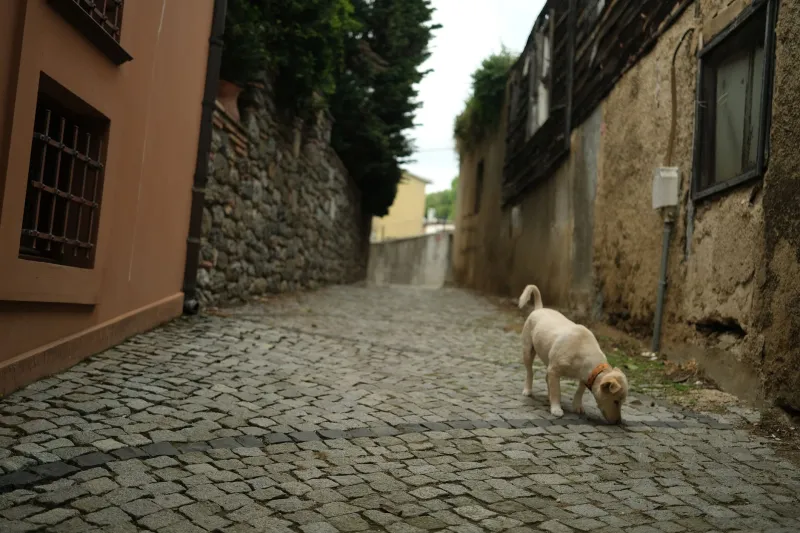
Quality matters more than quantity. A real sniff stop is usually three seconds or more, with the nose down, the body relaxed and the dog clearly processing. A quick tap of the nose on a lamp post is not the same. Watch where your dog chooses to linger: hedges, grass verges, wall corners, bin areas, the edge of the park. Those are information hotspots. If your dog rushes from scent to scent without settling, the walk may be too fast or too stressful.
Pace
Pace is a conversation. Is your dog pulling towards something or lagging behind? Does the pace change at the same corner every day? A dog who charges ahead may be excited, frustrated or simply used to a tight lead. A dog who trails may be tired, sore, anxious or bored. Neither is a diagnosis. It is a clue.
Stopping and starting
Choice is enrichment. If your dog never gets to stop, the walk becomes a commute. If they stop constantly and you drag them on, ask why. Are they checking a scent, avoiding a noise, or waiting for a treat? A dog who plants near a school gate at 3pm may be telling you something about noise, crowds or traffic.
Stress signals
Look for lip licking, yawning, shaking off, tail tucked, sudden freezing, scanning, or a body that stiffens when another dog appears. One signal is not a crisis. A cluster of signals on every walk is worth noting. If your dog is stressed on the same route every day, changing the time or the direction may help more than changing the lead.
The 15-minute audit
Do this on a normal walk, not a special outing. Keep the route the same so you have a baseline. Put your phone on silent, unless you are using it to note timings. You do not need a clipboard, though a notes app is fine.
- Minutes 0-3: baseline. As you leave the house, note your dog’s body. Are they pulling, bouncing, sniffing, scanning or hanging back? Is the lead tight? Is the tail high, low or neutral? This is your starting point.
- Minutes 3-8: sniff count. Count the real sniff stops, the ones lasting three seconds or more. Note where they happen: estate hedge, park gate, pavement crack, grass verge. Do not encourage or interrupt unless it is unsafe. Just count.
- Minutes 8-12: pace check. Pick three landmarks on your route, such as a corner, a bin or a bench. At each one, ask: is my dog ahead, beside or behind me? Is the lead loose or tight? Are they moving because they want to, or because I am pulling?
- Minutes 12-15: stress scan and choice. Look for stress signals and give your dog one safe choice. At a quiet junction, let them choose left or right. At a park edge, let them decide whether to sniff the hedge or carry on. Note what they choose.
A rough tally helps. If you get fewer than two real sniff stops in 15 minutes, the walk may be too rushed. If you get five or more and your dog’s body is loose, you are probably onto something. If your dog shows stress signals at the same point every time, that is not a training failure; it is information.
UK route ideas that add novelty without a trek
You do not need a National Trust membership to vary a local walk. Start small.
- Estate pavements: Walk the same loop in the opposite direction. Swap sides on quiet residential roads. Let your dog sniff the grass verges and wall corners where it is safe and not someone’s front garden. Avoid litter and broken glass.
- Local parks: Use a different entrance. Walk the perimeter instead of the main path. Sit on a bench for two minutes and let your dog watch the world. Check park rules and keep to lead areas where required.
- Pavement sniffari: Do ten minutes of slow sniffing and five minutes of brisk walking. This is especially useful before work or after a day alone. It gives the dog a job without adding distance.
- Weather routes: In wet weather, choose quieter streets with good drainage. In summer, check pavement heat with the back of your hand and walk early or late. In winter, avoid icy patches and use well-lit routes.
When to change the route, not just the pace
If your dog freezes at the same road crossing, tries to turn back at the same corner, or stops sniffing altogether, pay attention. Sudden changes in walk behaviour can be pain, fear or illness. Speak to your vet if the change is abrupt or comes with other symptoms. For milder cases, try a different time of day, a quieter direction or a shorter loop with more sniffing. A midday walker can also break up a long day, but only if the walker understands your dog’s pace and stress signals.
Make it a monthly habit
Repeat the audit once a month, or whenever your dog’s routine changes. You are not looking for a perfect walk. You are looking for signs that your dog is still curious, comfortable and allowed to make small choices. The same old walk can be brilliant. It just needs to be a walk, not a commute.
The point is not to turn every stroll into a field study. It is to notice when the familiar route has stopped offering your dog a life. Fifteen minutes of attention is often worth more than an extra mile.